Technology: Why Sensor-Fusion is Winning L4/L5
A deep dive into deterministic depth sensing, verifiable redundancy, and the cost-scaling roadmap for LiDAR architectures.
The Limitation of Neural Probabilities
In a vision-only system, depth and spatial relationships are inferred through stereoscopic analysis and temporal tracking via neural networks. When the system encounters an object it hasn't seen in its training data (a unique edge case), its probabilistic confidence drops. If the network guesses wrong at high speeds, the result can be catastrophic.
The Deterministic Advantage of LiDAR
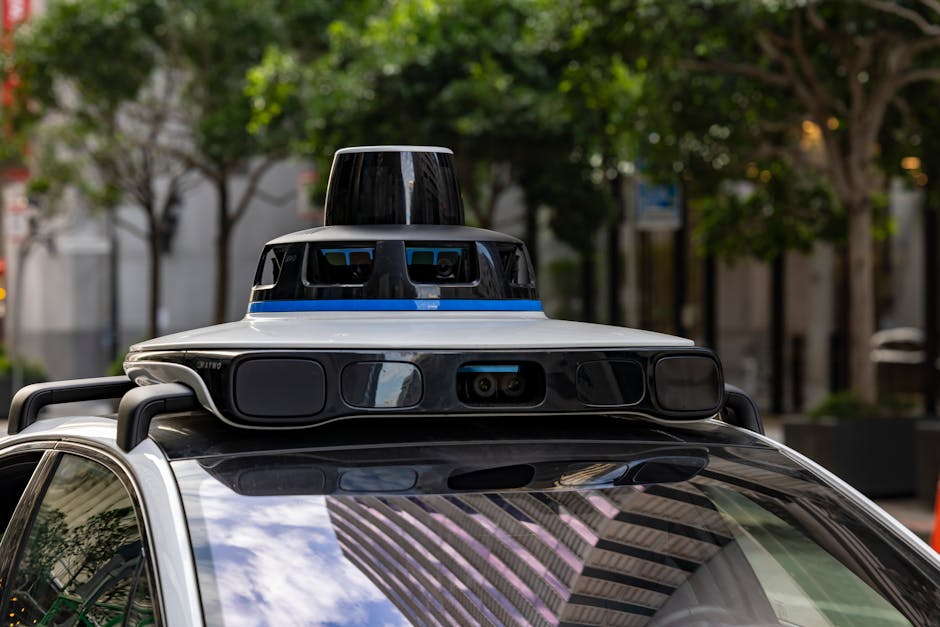
LiDAR (Light Detection and Ranging) bypasses inference. By measuring the exact time-of-flight (ToF) of millions of laser pulses per second, it creates a deterministic, millimeter-accurate 3D map (point cloud). A LiDAR sensor doesn't need to "know" what an object is to know exactly where it is and how fast it is moving.
Key Technological Paradigms
| Technology | Mechanism | Investment Implication |
|---|---|---|
| Mechanical ToF | Spinning arrays of lasers providing 360-degree FOV. | Legacy tech. High BOM, moving parts prone to failure. Not viable for mass passenger auto. |
| Solid-State / MEMS | Micro-mirrors steering stationary lasers. | Current industry standard. Excellent cost-to-performance ratio. Scalable for L3 ADAS integration. |
| FMCW | Measures frequency phase shifts to provide instant per-pixel velocity (Doppler effect). | Next-generation. Silicon photonics integration promises ultra-low cost at scale, but carries high current R&D risk. |
Redundancy and Regulatory Moats
True Level 4/5 autonomy means the driver is removed from the liability equation. Regulatory bodies globally (NHTSA in the US, UNECE in Europe) are coalescing around the need for safety redundancy. Sensor-fusion ensures that the failure of one sensor modality (e.g., mud on a camera lens) is instantly compensated by another deterministic sensor.
Cost-Scaling Outlook
Historically, LiDAR was a $75,000 spinning bucket on a prototype roof. Today, solid-state sensors fit behind the windshield or grille for under $500. As volume ramps with major OEM integrations (e.g., Volvo, Mercedes, Lotus), economies of scale will drive unit economics below $200 by 2027, neutralizing the primary "cost" argument of vision-only proponents.